Advantages and Disadvantages of Rotary Evaporators
2026-01-04
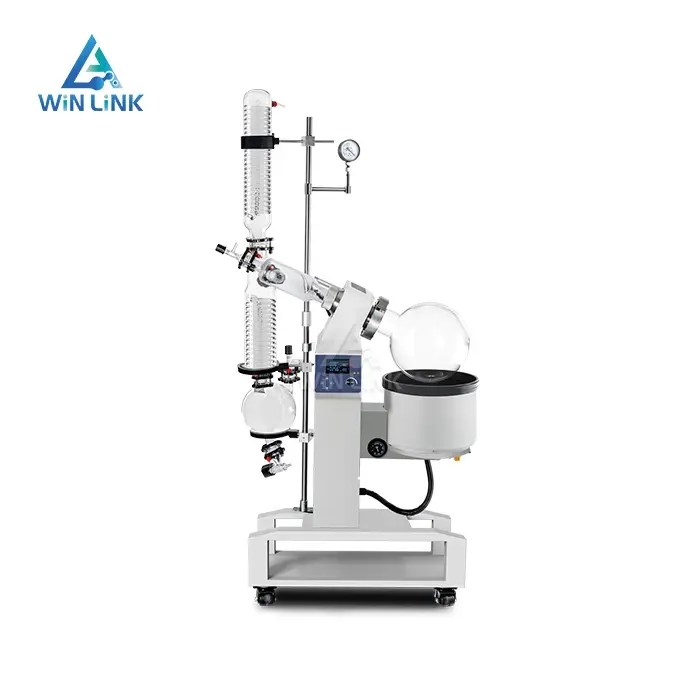
As a commonly used laboratory instrument, rotary evaporators have significant advantages and certain disadvantages. The detailed analysis of their advantages and disadvantages is as follows:
Advantages
Efficiency
Rotary evaporators form a thin film by rotating the flask, which greatly increases the evaporation surface area of the liquid, thereby significantly improving the evaporation rate. The vacuum system reduces the boiling point of the liquid, allowing the solvent to evaporate quickly at a lower temperature, further shortening the operation time.
Sample Protection
Working under vacuum conditions lowers the boiling point of the liquid, avoiding the damage of high temperature to heat-sensitive samples. Under low-temperature evaporation conditions, the active ingredients and heat-sensitive substances in the sample will not degrade or inactivate due to high temperature, ensuring the integrity and activity of the sample.
Solvent Recovery
The condensation system can condense the evaporated solvent vapor, with a high solvent recovery rate, reducing solvent waste. The recovered solvent can be reused, reducing experimental costs and solvent emissions, which is environmentally friendly.
Safety
Rotary evaporators are equipped with multiple safety protection functions, such as temperature control, vacuum degree adjustment and anti-splash design, ensuring the safety and reliability of the experimental process. The closed design reduces the leakage of harmful vapors, protecting the health of operators.
Wide Applicability
Rotary evaporators can be used in multiple fields such as chemical synthesis, drug development, biotechnology, food industry and environmental science, with wide applicability. They can handle various organic solvents and aqueous solutions, adapting to different experimental needs.
Automation and Convenience
Modern rotary evaporators are equipped with automatic control systems, such as temperature control and vacuum degree adjustment, reducing the risk and complexity of manual operation. Many rotary evaporators are equipped with digital displays and key controls, making the operation more intuitive and convenient.
Disadvantages
Sample Volume Limitation
Although a rotary evaporator can handle a relatively large volume of a single sample at one time, its sample processing capacity is still limited compared to other batch processing equipment.
Sample Property Limitation
It cannot handle highly volatile and strongly corrosive samples, which may damage the equipment or affect the evaporation effect. It is difficult to separately recover mixed solvents during the evaporation process, which may affect the accuracy of subsequent analysis or purification.
Difficulty in Processing Trace Samples
Rotary evaporators are difficult to process trace samples (such as microplates, 1.5ML tubes, etc.) and may not achieve the ideal evaporation effect.
Seal Life
The seals of rotary evaporators need to be replaced regularly to ensure the tightness and normal operation of the equipment. This increases the maintenance cost and operational complexity of the equipment.
Heating Method May Affect Biological Activity
The heating method of some rotary evaporators may not fully ensure the stability of bioactive substances, which needs special attention during the experiment.
In summary, rotary evaporators have advantages such as high efficiency, safety, environmental protection and wide applicability in laboratories, but they also have disadvantages such as sample volume limitation, sample property limitation and difficulty in processing trace samples. In the process of use, it is necessary to make reasonable selection and operation according to experimental needs and equipment characteristics.
YOU MAY LIKE
_1769649684517.webp "Yokogawa YTA110 Temperature Transmitter")