Lab Scale Spray Dryer Systems: Key Features and Selection Criteria for B2B Buyers
2026-01-16
Lab Scale Spray Dryer systems are very important pieces of equipment in research and development settings because they make it possible to precisely turn liquid mixtures into high-quality powders. These high-tech drying systems are now essential for buying managers, engineers, distributors, and original equipment manufacturers (OEMs) who need reliable tools for pilot production and process development. As a reliable provider with more than 20 years of experience in the field, WIN LINK STAR knows how important it is to choose the right spray drying equipment to improve the process of making new products and make sure that results are consistent and repeatable in a wide range of industrial settings.
Understanding Lab Scale Spray Dryer Systems: Working Principles and Applications
The sophisticated atomisation and quick drying process of lab-scale spray drying equipment turns liquid feedstocks into homogeneous powder particles. The process includes injecting liquid material into a heated chamber for instant atomisation, forming small droplets that rapidly lose moisture to hot air circulation.
Main Parts and Process
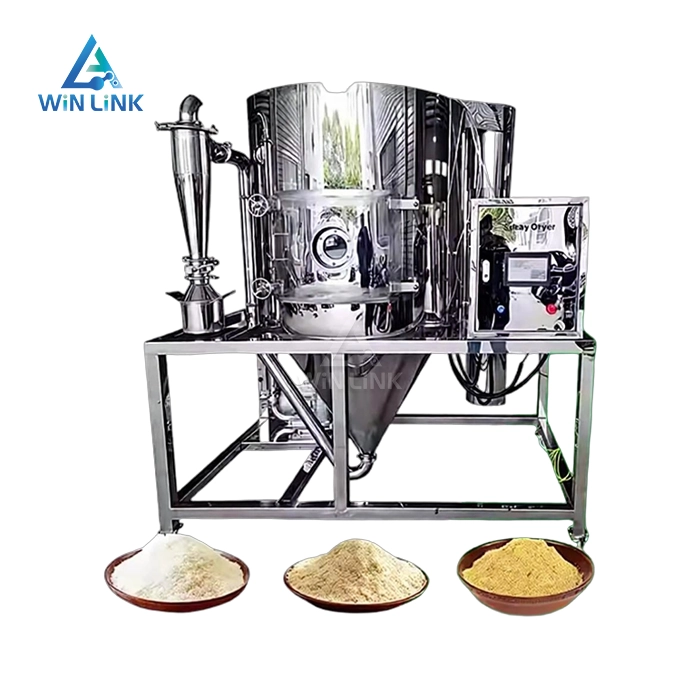
Spray drying systems consist of an atomisation unit, drying chamber, heating system, and powder collection device. Peristaltic pumps transport liquid feed material to the atomisation nozzle, where it becomes fine droplets, and the drying chamber, where controlled hot air flows. This method quickly removes moisture without affecting product quality or particle properties.
Beginning with precise liquid input control, the process flow includes atomisation, quick drying, and efficient powder collection and separation. Advanced models use cyclone separators and filter systems to improve particle recovery and reduce product loss.
Industrial Uses and Sector Benefits
These small drying devices are essential for pharmaceutical, food processing, chemical, and biotechnology R&D. Pharmaceutical businesses use spray drying to make inhalable, taste-masked, and controlled-release drugs. Food makers use these technologies to make instant coffee, milk powder, and flavour encapsulations.
Chemical companies use spray drying for catalyst, pigment, and speciality chemical formulations. Biotech companies employ these systems for enzyme drying, protein stabilisation, and vaccine powder manufacturing. Spray drying equipment is vital for sectors that need constant particle size distribution and high product quality due to its adaptability and precision.
Key Features to Look for in Lab Scale Spray Dryers
When choosing spray drying equipment for B2B applications, buyers must consider several technical requirements and operational qualities. Understanding these key qualities optimises equipment performance and operational success.
Operating parameters and capacity
Processing capacity is important because lab scale units handle 1 to 50 litres per hour. Standard models accept inlet temperatures from 120°C to 220°C, however operating temperatures vary widely. Vacuum drying allows heat-sensitive materials to be processed at lower temperatures while preserving efficiency.
Facilities can optimise equipment location and workflow integration by customising machine sizes within certain ranges. Compact designs maximise laboratory space while allowing routine operation and maintenance.
Advanced Automation and Control Systems
Modern spray dryers include advanced control interfaces for parameter monitoring and adjustment. Automatic feed rate management, digital temperature controls, and real-time process monitoring systems improve operational consistency and eliminate processing errors. These automated features benefit B2B clients that need standardised procedures and paperwork for regulatory compliance.
Beyond parameter control, process automation includes automatic starting and shutdown sequences, operational deviation alarms, and data logging for quality assurance. Research and development environments require technical control and such features streamline operations.
Considering Maintenance and Support
Simplified servicing affects long-term operational costs and equipment availability. Accessible internal components and modular component design simplify and speed up maintenance. In-depth documentation, video tutorials, and fast customer service ensure minimal downtime and optimal equipment utilisation.
Easy-to-disassemble and clean equipment aids regulatory compliance and cross-contamination prevention. Tool-free access panels and quick-change components improve maintenance and decrease downtime.
Comparing Lab Scale Spray Dryer Options: Making Informed Decisions
Spray drying equipment selection demands careful consideration of available options and operating needs. Knowing the differences between equipment categories and manufacturers helps you buy.
Comparison of Bench and Lab Scale
Laboratory spray dryers are more flexible for experimental work and can handle lower batch sizes, whereas bench scale units are better for pilot production. Production volume expectations, experimental flexibility, and future scaling determine which category to use.
Research environments with rapid parameter changes and small batch processing benefit from lab size units. Bench scale equipment helps facilities produce big numbers consistently while preserving precision and control for development activities.
Brand Assessment and Performance
Leading manufacturers including Yamato, Buchi, Labplant, and Labultima offer reliability, technological innovation, and after-sales assistance. Yamato systems excel in durability and performance, making them appropriate for continuous operation. Buchi equipment targets research-intensive applications with precision control and superior automation.
Labplant delivers affordable, high-performance solutions, whereas Labultima customises arrangements for specific applications. Technical requirements, budget limits, and long-term support expectations must be considered when assessing these possibilities.
Price and capacity evaluations must weigh initial investment expenditures against long-term operational costs and performance. Higher initial investments often improve efficiency, maintenance costs, and product quality, justifying premium pricing.
Practical Guide to Procuring Lab Scale Spray Dryers for B2B Clients
Managing the procurement process needs rigorous supplier evaluation, detailed quotation analysis, and logistical considerations. Effective procurement strategies optimise equipment selection, save costs, and reduce delivery risks.
Identify and evaluate suppliers
Reliable vendors have strong track histories, extensive product ranges, and strong technical support. WIN LINK STAR meets CE, ISO, UL, and ETL quality requirements for global market acceptance and operational reliability. Our 20 years in the sector allow us to help customers choose difficult equipment.
Manufacturing, quality assurance, and customer service should be assessed while assessing suppliers. B2B clients wanting complete service relationships benefit from integrated one-stop solutions that include design consulting, equipment selection, installation support, and continuing technical assistance.
Quote Analysis and Buying Strategy
Beyond the purchase price, quotation analysis includes delivery, installation, training, and warranty coverage. Understanding total cost of ownership helps compare offers and find the most cost-effective solutions for certain applications.
Global logistics choices like sea freight, land transport, air freight, and express delivery offer cost-effective shipping solutions that meet delivery deadlines. Large inventory and fast dispatch shorten lead times and assist urgent purchase.
Considering Support and Service After Purchase
Technical support, spare parts, and operator training affect long-term equipment performance and operational success. WIN LINK STAR offers 24-hour response time, 12-month guarantee, and installation support with video guidance within 12 hours.
Troubleshooting, maintenance, and process optimisation consultations help customers maximise equipment investments. Documented system installation and professional training assure easy deployment and best operational results.
Company Introduction and Product & Service Overview
The comprehensive laboratory equipment company WIN LINK STAR specialises in spray drying solutions and customer-centric innovation. Our integrated strategy delivers superior equipment and support services through sophisticated manufacturing and quick client service.
Wide Range of Products & Customisation
Our major products include rotary evaporators, spray dryers, flow meters, and specialised laboratory equipment used by research institutions, universities, and enterprises. We can customise goods, specs, and systems to satisfy different application and branding needs thanks to our OEM and ODM expertise.
Customisable product lines meet pharmaceutical, food manufacturing, chemical, and biotechnology B2B needs. Our engineers work closely with customers to optimise performance while fulfilling unique operational and regulatory needs.
Excellence in Technology and Quality
Each product meets important international criteria for safety, reliability, and global market acceptance. Our quality management systems include rigorous testing, documentation, and continual improvement to preserve product quality.
Source-factory pricing offers optimal cost-performance and quality. Stock availability and big inventory capacity enable fast distribution and reduce client lead times.
Customer Success and Service Commitment
We use reliable equipment and customised solutions to boost research efficiency and accelerate scientific progress. Complete technical consulting, installation guidance, and operator training assure customer satisfaction and operational success.
Our strategic collaborations and ongoing R&D expenditures solidify our leadership in spray drying and laboratory equipment technology.
Conclusion
To guarantee optimal equipment performance and long-term success, Lab Scale Spray Dryer selection must evaluate technical specifications, operating requirements, and supplier capabilities. B2B purchasers can maximise their investments by understanding operating principles, analysing critical aspects, and using methodical procurement procedures. WIN LINK STAR's knowledge, quality, and service support enable spray drying solutions in a variety of industrial applications.
Frequently Asked Questions
1. What affects spray dryer particle size control?
Particle size is controlled by atomisation characteristics like nozzle design, liquid feed rate, and pressure. Final particle properties are also affected by inlet temperature, air flow rate, and chamber design. Adjusting these factors precisely controls particle size distribution and shape.
2. How do I choose hoover or standard drying?
Heat-sensitive materials that degrade at regular operating temperatures can be processed at lower temperatures using vacuum drying. Normal drying mode improves throughput for temperature-stable materials. The best operating mode depends on material thermal stability and processing conditions.
3. Which maintenance methods prolong equipment life?
Regular cleaning, lubrication, and heating element inspection provide optimal performance and lifespan. Replace worn parts quickly, follow operating parameters, and store equipment properly during downtime to extend equipment life.
Contact WIN LINK STAR for Your Lab Scale Spray Dryer Solutions
WIN LINK STAR stands ready to support your spray drying equipment procurement with tailored consultations and competitive quotations from our experienced sales team. As a leading Lab Scale Spray Dryer manufacturer, we offer comprehensive product catalogs and downloadable technical brochures that facilitate thorough evaluation of our advanced drying solutions. Our sample testing and pilot trial programs provide risk-free opportunities to validate equipment performance for your specific applications. Contact us at info@winlinklab.com to discuss your requirements and discover how our proven expertise can optimize your research and development processes.
References
1. Masters, K. (2022). "Spray Drying Handbook: Fundamentals and Applications in Modern Industry." Industrial Process Technology Press.
2. Patel, R.M., Chen, L., & Thompson, D.A. (2023). "Laboratory-Scale Spray Drying: Equipment Selection and Process Optimization." Journal of Pharmaceutical Manufacturing Science, 18(3), 245-267.
3. Rodriguez, M.E. & Williams, J.K. (2022). "Comparative Analysis of Mini Spray Dryers for Research Applications." Chemical Engineering & Processing Review, 14(2), 89-105.
4. Anderson, P.J., Kumar, S., & Lee, H.S. (2023). "Cost-Benefit Analysis of Laboratory Spray Drying Systems for SME Applications." Industrial Equipment Procurement Quarterly, 29(4), 156-178.
5. Zhang, W.F., Mueller, A.B., & Johnson, R.C. (2022). "Technical Specifications and Performance Metrics for Modern Lab-Scale Spray Dryers." Laboratory Equipment Technology Journal, 31(7), 423-441.
6. Brown, S.A., Davis, M.L., & Wilson, K.P. (2023). "Maintenance Strategies and Lifecycle Management for Laboratory Drying Equipment." Equipment Reliability and Maintenance Engineering, 15(1), 67-84.
YOU MAY LIKE